

|
|
||||
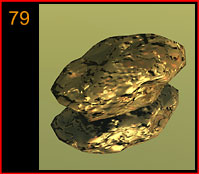 |
Gold - Au General Information Discovery Gold was known to ancient civilisations, and has always been a valued metal. Appearance Of all the elements, gold is the most beautiful. It is a soft metal with a characteristic yellow colour and sheen. Source Gold is found in nature both free in veins and combined in alluvial deposits. About two thirds of the world. s output comes from South Africa. Refining is usually by electrolysis, but gold in ores is recovered by a smelting process. Uses Gold is used for coinage and is a standard for monetary systems in many countries. It is also used extensively in jewellery. The term carat expresses the amount of gold present in an alloy; 24 carat is pure gold, and most jewellery is 9 carat gold. Gold is used in dental work, and the isotope 198Au, with a half-life of 2.7 days, is used for treating cancer. A gold compound is used in certain cases to treat arthritis. Another gold compound is used in photography for toning the silver image. Biological Role Gold has no known biological role, and is non-toxic. General Information Gold has the highest malleability and ductility of any element. It is unaffected by air, water, all acids except aqua regia, and alkalis. It is a good conductor of heat and electricity. It is also a good reflector of infra-red radiation, and as it is inert makes an excellent coating for space satellites. |
| Physical Information | |||
| Atomic Number | 79 | ||
| Relative Atomic Mass (12C=12.000) | 196.97 | ||
| Melting Point/K | 1337.58 | ||
| Boiling Point/K | 3080 | ||
| Density/kg m-3 | 19320 (293K) | ||
| Ground State Electron Configuration | [Xe]4f145d106s1 | ||
| Electron Affinity(M-M-)/kJ mol-1 | 223 |
| Key Isotopes | ||||||
| nuclide | 195Au | 197Au | 198Au | 199Au | ||
| atomic mass | 196.97 | |||||
| natural abundance | 0% | 100% | 0% | 0% | ||
| half-life | 183 days | stable | 2.69 days | 3.15 days |
| Other Information | ||
| Enthalpy of Fusion/kJ mol-1 | 12.7 | |
| Enthalpy of Vaporisation/kJ mol-1 | 343.1 | |
| Oxidation States | ||
| main | AuIII | |
| others | Au-I, AuO, AuI, AuII, AuV, | |
| AuVII | ||
| Covalent Bonds /kJ mol-1 | ||
| not applicable | ||
| Ionisation Energies/kJ mol-1 | ||
| M - M+ | 890.1 | |
| M+ - M2+ | 1980 | |
| M2+ - M3+ | 2900 | |
| M3+ - M4+ | 4200 | |
| M4+ - M5+ | 5600 | |
| M5+ - M6+ | 7000 | |
| M6+ - M7+ | 9300 | |
| M7+ - M8+ | 11000 | |
| M8+ - M9+ | 12800 | |
| M9+ - M10+ | 14800 | |
 |
 |
 |