

|
|
||||
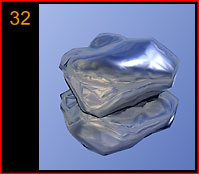 |
Germanium - Ge General Information Discovery Germanium was discovered by C.A. Winkler in 1886 in Freiberg, Germany. It was predicted by Mendeleev in 1871 who named it ekasilicon. Appearance Germanium is a grey-white metalloid, crystalline and brittle, retaining a lustre in air. Source Germanium is found in small quantities in the minerals germanite and argyrodite. It is also present in zinc ores, and commercial production of germanium is by processing zinc smelter flue dust. It can also be recovered from the by-products of combustion of certain coals, which ensures a copious future supply. Uses Germanium is a very important semiconductor. The pure element is doped with arsenic, gallium or other elements and used as a transistor in thousands of electronic applications. Germanium is also finding use as an alloying agent, in fluorescent lamps and as a catalyst. Both germanium and germanium oxide are transparent to infrared radiation and so are used in infrared spectroscopes. Germanium oxide has a high index of refraction and dispersion and is used in wide-angle camera lenses and microscope objectives. Biological Role Germanium has no known biological role. It is non-toxic. Certain germanium compounds have low mammalian toxicity but marked activity against some bacteria, which has stimulated interest in their use in pharmaceutical products. |
| Physical Information | |||
| Atomic Number | 32 | ||
| Relative Atomic Mass (12C=12.000) | 72.61 | ||
| Melting Point/K | 1210.6 | ||
| Boiling Point/K | 3103 | ||
| Density/kg m-3 | 5323 (293K) | ||
| Ground State Electron Configuration | [Ar]3d104s24p2 | ||
| Electron Affinity(M-M-)/kJ mol-1 | 116 |
| Key Isotopes | ||||||
| nuclide | 68Ge | 70Ge | 71Ge | 72Ge | 73Ge | |
| atomic mass | 67.928 | 69.924 | 70.925 | 71.923 | 72.923 | |
| natural abundance | 0% | 20.5% | 0% | 27.4% | 7.8% | |
| half-life | 287 days | stable | 11.4 days | stable | stable | |
| nuclide | 74Ge | 76Ge | 77Ge | |||
| atomic mass | 73.922 | 75.921 | ||||
| natural abundance | 36.5% | 7.8% | 0% | |||
| half-life | stable | stable | 11.3 h | |||
| Other Information | ||
| Enthalpy of Fusion/kJ mol-1 | 34.7 | |
| Enthalpy of Vaporisation/kJ mol-1 | 327.6 | |
| Oxidation States | ||
| GeII, GeIV | ||
| Covalent Bonds /kJ mol-1 | ||
| Ge - H | 288 | |
| Ge - C | 237 | |
| Ge - O | 363 | |
| Ge - F | 464 | |
| Ge - Cl | 340 | |
| Ge - Ge | 163 | |
| Ionisation Energies/kJ mol-1 | ||
| M - M+ | 762.1 | |
| M+ - M2+ | 1537 | |
| M2+ - M3+ | 3302 | |
| M3+ - M4+ | 4410 | |
| M4+ - M5+ | 9020 | |
| M5+ - M6+ | 11900 | |
| M6+ - M7+ | 15000 | |
| M7+ - M8+ | 18200 | |
| M8+ - M9+ | 21800 | |
| M9+ - M10+ | 27000 | |
 |
 |
 |